• Home
  • Organization
    • About
    • Officers
    • Committee’s
    • Agencies
    • The Conservation Pledge
    • Outdoorsmen Prayer
  • Calendar
  • Clubs
    • Aliquippa Bucktails
    • Ambridge District Sportsmen’s Association
    • Beaver County Sportsmen’s Youth Foundation
    • Beaver Falls Sportsmen’s Association
    • Beaver Valley Archers
    • Beaver Valley Rifle & Pistol Club
    • Conway Sportsmen’s Club
    • Firearms Owners Against Crime
    • Five Points Hunting Club
    • Green Valley Sportsman’s Club
    • Midland Sportsmen’s Club
    • North Borough Sportsmen’s Association
    • Pine Run Sportsmen’s Club
    • Pittsburgh Downriggers, Inc
    • Rochester Sportsmen’s Club
    • Sewickley Valley Conservation Association
  • Events
    • Hunters Education
    • Fund Raising
    • Hereford Manor Lake
  • Youth
    • Youth Programs
    • Youth Foundation
    • Donate To Youth Foundation
  • Legislation
    • FOAC
    • Action Day Rally’s
  • News
    • PA Game Commission
    • PA Fish And Boad Commission
    • Eagle Cams
    • Second Admendment
  • Minutes
  • Contact

Beaver County Sportsmen's Conservation League

To promote and foster, the protection and conservation of our wildlife resources

PENNSYLVANIA GAME COMMISSION RUFFED GROUSE FILM WINS BIG

October 3, 2018 by BCSCL Staff

Watch the 9-minute film

Between 2001 and 2005, the ruffed grouse population suffered a 63 percent decline in Pennsylvania. No one was sure why but in 2015 through 2016, Game Commission biologist Lisa Williams and her team confirmed their suspicions about Pennsylvania’s state bird being affected by the West Nile Virus (WNV).

Grouse chicks were hatched from eggs gathered in the wild, and then inoculated with WNV. Within the first week 40 percent of the chicks died. After two weeks, an additional 40 percent of the chicks showed so much organ damage that they probably could not have survived in their natural environment.

After the challenge study was completed, the laboratory findings were then tested on wild grouse in Pennsylvania by looking for WNV-positive antibodies in harvested grouse. This testing is the first of its kind where lab results were then tested in wild populations.

Williams rallied hundreds of hunters across the state to send in blood samples when they harvested a grouse during the hunting season. Game Commission pathologist Justin Brown and their research partners at Colorado State University and the University of Guelph then did the careful lab work to assess WNV exposure in wild grouse. By incorporating these findings into habitat management planning, the Game Commission and partners hope to direct habitat management efforts to areas where grouse populations have the best chance of responding.

Williams’ research then caught the ear of one of the Game Commission staff filmmakers.

Game Commission filmmaker Tracy Graziano, armed with her Canon C500 and Final Cut X editing program, set out to tell Williams’ story that continues to unfold even today. Graziano completed the 9-minute documentary in late January 2017 after 18 months of shooting and countless hours in the field. She has been with the agency for eight years but has been creating science and wildlife documentaries since 1999.

“The most rewarding thing I can hope for in any of my film projects is to help influence change for the benefit of wildlife and conservation,” said Graziano.

“With more than 27,000 YouTube views to date, I believe the ‘Ruffed Grouse’ film was critically important in raising awareness among hunters about the risk of WNV to grouse and is one of the reasons other state wildlife agencies started looking into WNV as a contributing cause of decreasing grouse populations,” Lisa Williams said.

Game Commission Executive Director Bryan Burhans concurs.

“Lisa Williams’ research into the ruffed grouse population decline in Pennsylvania is cutting-edge science-based wildlife management,” Burhans said. “Documenting these important findings by using the latest technology by skilled filmmaker Tracy Graziano so others can learn and benefit exemplifies why the Pennsylvania Game Commission is at the forefront in modern wildlife management.”

“Ruffed Grouse” won awards from the following:

  • The University of Idaho Fish & Wildlife Film Festival 2017, Idaho, “Natural History Documentary-Short” category
  • American Conservation Film Festival 2017, West Virginia, Official Selection “Conservation Film Short” category
  • Wildlife Conservation Film Festival 2017, New York, Official Selection “Wildlife Conservation” category
  • FIIN 2017, Portugal, Official Selection “Films of Nature” category
  • NatureTrack Film Festival 2018, California, Official Selection “Conservation” category
  • Outdoor Film Festival 2018, Utah, Official Selection “Categories by Species”

This past July, the “Ruffed Grouse” film was recognized with its most recent award at the Association for Conservation Information (ACI) conference in Springfield, Missouri. The film took third place in the 2018 “Video Long” category.

ACI is a professional organization that recognizes excellence in educational work completed by state and federal fish and wildlife agencies across North America.
 

Filed Under: Hunting, PA Game Commission

CWD RULES AFFECT OUT OF STATE HUNTERS

October 3, 2018 by BCSCL Staff

HARRISBURG, PA – Pennsylvanians who harvest deer, elk, mule deer or moose out-of-state likely can’t bring them home without first removing the carcass parts with the highest risk of transmitting chronic wasting disease (CWD).

Pennsylvania long has prohibited the importation of high-risk cervid parts from areas where CWD has been detected. This prohibition reduces the possibility of CWD, which always is fatal to the cervids it infects, spreading to new areas within Pennsylvania.

Earlier this year, the Game Commission strengthened its ban on importing high-risk cervid parts by prohibiting any deer harvested in New York, Ohio, Maryland or West Virginia from being brought back to Pennsylvania whole.

In previous hunting seasons, the prohibition applied only to deer harvested within counties in those states where CWD has been detected.

With the change, Pennsylvanians who harvest deer anywhere in New York, Ohio, Maryland or West Virginia either must have them processed in those states or remove the high-risk parts before bringing the meat and other low-risk parts back into Pennsylvania.

There now are 24 states and two Canadian provinces from which high-risk cervid parts cannot be imported into Pennsylvania.

The parts ban affects hunters who harvest deer, elk, moose, mule deer and other cervids in: Arkansas, Colorado, Illinois, Iowa, Kansas, Maryland, Michigan, Minnesota, Mississippi, Missouri, Montana, Nebraska, New Mexico, New York, North Dakota, Ohio, Oklahoma, South Dakota, Texas, Utah, Virginia, West Virginia, Wisconsin and Wyoming; as well as the Canadian provinces of Alberta and Saskatchewan.

High-risk parts include: the head (including brain, tonsils, eyes and any lymph nodes); spinal cord/backbone; spleen; skull plate with attached antlers, if visible brain or spinal cord tissue is present; cape, if visible brain or spinal cord tissue is present; upper canine teeth, if root structure or other soft tissue is present; any object or article containing visible brain or spinal cord tissue; unfinished taxidermy mounts; and brain-tanned hides.

Hunters who are successful in those states and provinces from which the importation of high-risk parts into Pennsylvania is banned are allowed to import meat from any deer, elk, moose, mule deer or caribou, so long as the backbone is not present.

Successful hunters also are allowed to bring back cleaned skull plates with attached antlers, if no visible brain or spinal cord tissue is present; tanned hide or raw hide with no visible brain or spinal cord tissue present; capes, if no visible brain or spinal cord tissue is present; upper canine teeth, if no root structure or other soft tissue is present; and finished taxidermy mounts.

Hunters who harvest cervids in a state or province where CWD is known to exist also should follow instructions from that state’s wildlife agency on how and where to submit the appropriate samples to have their animal tested. If, after returning to Pennsylvania, a hunter is notified that his or her harvest tested positive for CWD, the hunter is encouraged to immediately contact the Game Commission region office that serves the county in which they reside for disposal recommendations and assistance.

A list of region offices and contact information can be found at www.pgc.pa.gov by scrolling to the bottom of any page to select the “Connect with Us” tab.

Pennsylvania first detected chronic wasting disease in 2012 at a captive deer facility in Adams County. The disease has since been detected in free-ranging and captive deer in a few, isolated areas of Pennsylvania.

Presently, there are three active Disease Management Areas (DMAs) within Pennsylvania where special regulations apply to help prevent CWD from spreading to new areas. Deer harvested within DMAs also cannot be transported whole to points outside the DMA.

Much more information on CWD and Pennsylvania’s DMAs is available at www.pgc.pa.gov.

MEDIA CONTACT: Travis Lau – 717-705-6541

Courtesy PA Game Commission

Filed Under: CWD, Hunting, PA Game Commission

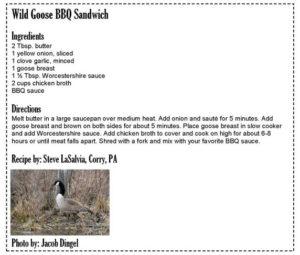
Wild Goose BBQ Sandwich

October 3, 2018 by BCSCL Staff

It’s Wild Game Wednesday!

Raise your hand if you’ve ever felt a special sense of pride when preparing a meal that included fresh, wild game. There is just something satisfying about knowing exactly where your meat came from that makes wild game meals even more appealing – and – appetizing! Oftentimes, there is an exciting story to accompany the game that’s been prepared. Delicious food paired with great conversation, what more could you ask for?

On Wild Game Wednesday, we take a moment to recognize one of the most important reasons people take to the woods and fields to hunt: to fill their freezers with types of fresh, organic meat. These weekly posts include delicious, easy and in-season wild game recipes from the Pennsylvania Game Commission’s Game Cookbook that you and your family can prepare.

For all our goose hunters out there, this one is for you! Let us know if you try this recipe.

Wild Goose BBQ Sandwich

If you are interested in more wild game recipes submitted by people from around Pennsylvania, visit www.theoutdoorshop.state.pa.us/FBG/ to purchase the second edition of the cookbook for less than $10!

Courtesy PA Game Commission

Filed Under: Hunting, PA Game Commission

View The Live Elk Cam

October 3, 2018 by BCSCL Staff

We realize not everyone will be able to visit Benezette this fall, but we still want you to have the elk-viewing opportunity. The live elk cam streaming on our website lets you be able to watch for elk from the comfort of your own home! WATCH IT LIVE HERE. We’ve had a very active elk cam season so far this season, so be sure to check it out. The best times to view are at dawn and dusk. You may also see white-tailed deer, turkeys and groundhogs. This stream is the product of the coordinated efforts of the Pennsylvania Game Commission, HDonTap and the North Central Pennsylvania Regional Planning and Development Commission.

CLICK HERE TO LEARN MORE ABOUT ELK IN PENNSYLVANIA.

Courtesy PA Game Commission

Filed Under: Hunting, PA Game Commission

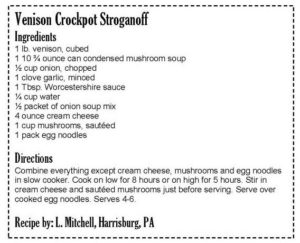
Venison Crockpot Stroganoff

October 3, 2018 by BCSCL Staff

It’s Wild Game Wednesday!

Do you have extra venison in the freezer you’ve been meaning to use? Archery season opens statewide this weekend, Sept. 29, so if you’re looking to cook the meat before this year’s deer season, this recipe might be perfect for you!

On Wild Game Wednesday, we take a moment to recognize one of the most important reasons people take to the woods and fields to hunt: to fill their freezers with types of fresh, organic meat.

These weekly posts include delicious, easy and in-season wild game recipes from the Pennsylvania Game Commission’s Game Cookbook that you and your family can prepare.

Let us know if you try this recipe. Enjoy!

Venson Crockpot Stroganoff

If you are interested in more wild game recipes submitted by people from around Pennsylvania, visit www.theoutdoorshop.state.pa.us//FBG/game/GameProductSelect.asp?catid=BKS to purchase the second edition of the cookbook for less than $10!

Courtesy PA Game Commission

Filed Under: Archery, Hunting, PA Game Commission

What is DMA?

October 3, 2018 by BCSCL Staff

Because we know there are a lot of acronyms posted on the Internet, we want to take a moment to explain some of our most important ones.

Chronic wasting disease, also commonly known as CWD, infects deer, elk and moose, specifically their brain and nervous system, eventually resulting in their death. It can be passed from one animal to another by direct contact, or indirectly when a healthy animal comes in contact with the prion that causes CWD, which is shed by infected animals.

When CWD is detected in a new area, the Game Commission responds by designating a Disease Management Area, or DMA, within which special rules apply regarding the hunting and feeding of deer.

As new cases emerge near a DMA boundary, those DMAs are expanded to encompass larger areas.

CWD first appeared in Pennsylvania in 2012, when it was detected in deer at a captive facility in Adams County, then a few months later, in free-ranging deer in Blair and Bedford counties. Since then, it has been detected in dozens more captive and free-ranging deer. The disease itself was first identified in 1967.

Since last year at this time, DMA 4 has been formed, spanning parts of Lancaster, Lebanon and Berks counties. Meanwhile, DMA 2 and DMA 3 have both been expanded.

DMA 2 now totals more than 4,614 square miles and includes parts of Juniata, Mifflin and Perry counties, in addition to all or parts of Adams, Bedford, Blair, Cambria, Clearfield, Cumberland, Franklin, Fulton, Huntingdon and Somerset counties.

DMA 3 has been expanded to more than 916 square miles. It now includes parts of Armstrong, Cambria and Clarion counties, as well as parts of Clearfield, Indiana and Jefferson counties. Maps and turn-by-turn descriptions of DMA boundaries can be found on the CWD page at the Game Commission’s website.

CLICK HERE FOR AN INTERACTIVE MAP OF PENNSYLVANIA’S DMAS.

With archery season right around the corner, the Game Commission is taking part in several informational events across the three DMAs where the disease has been detected and special rules are in place to help the public better understand CWD and what it means for Pennsylvania’s deer and deer hunting.

DMAs serve to limit CWD’s spread. Hunters who harvest deer within a DMA are prohibited from transporting the deer outside the DMA unless they first remove the carcass parts with the highest risk of transmitting CWD. The meat, the hide and antlers attached to a clean skull plate may be removed from a DMA.

High-risk parts include the head (including brain, tonsils, eyes and lymph nodes); spinal cord and backbone (vertebrae); spleen; skull plate with attached antlers, if visible brain or spinal cord material is present; cape, if visible brain or spinal cord material is present; upper canine teeth, if root structure or other soft material is present; any object or article containing visible brain or spinal cord material; and brain-tanned hide. The use or field possession of urine-based cervid attractants, and the feeding of deer also are prohibited within DMAs.

Hunters who harvest a deer within one of Pennsylvania’s three DMAs can deposit the head of their deer into any CWD Collection Container, pictured below, for free testing and for biological surveillance purposes. The harvest tag must be filled out completely, legibly and physically attached to the deer’s ear. The head must be placed in a plastic garbage bag and sealed before being placed in the collection bin. Hunters will be notified of test results. Skulls and antlers will not be returned.

To date, there have been no reported cases of CWD infection in people, according to the Centers for Disease Control and Prevention (CDC). But the disease is always fatal to the cervids it infects As a precaution, CDC recommends people avoid eating meat from deer and elk that look sick or that test positive for CDW.

Currently, there is no practical way to test live animals for CWD, nor is there a vaccine. Clinical signs of CWD include poor posture, lowered head and ears, uncoordinated movement, rough-hair coat, weight loss, increased thirst, excessive drooling, and, ultimately, death.

If you have questions about CWD or a DMA, contact your region office

Courtesy PA Game Commission

Filed Under: CWD, Hunting, PA Game Commission

Reminding Archers to Hunt Safely and to Wear a Harness

September 13, 2018 by BCSCL Staff

Archery season in Pennsylvania opens statewide on Saturday, Sept. 29. In an effort to reduce the number of tree stand injuries this hunting season, the Pennsylvania Game Commission is reminding hunters to hunt safely and to wear a harness.

Unfortunately, hundreds of hunters in Pennsylvania have been seriously injured in tree stand-related accidents. Fall-arrest systems and full-body harnesses have the ability to save lives and are the best methods for keeping hunters from being hurt in a fall.

Here are some important safety tips to remember:

  • Make sure the harness is on before climbing the ladder.
  • Read the manufacturers’ warnings and instructions before using the stand. Call the manufacturer with any questions or concerns.
  • Practice climbing before the season begins and use all provided safety devices. The transitions in and out of the stand are the most dangerous times.
  • Plan to use a haul rope to pull gear, including unloaded firearms and bows, to the tree stand from the ground once safely and properly positioned.
  • Be prepared to self-rescue, should a fall occur. We recommend carrying a screw-in step or a relief strap so that you can hang comfortably until you are rescued, or so you can rescue yourself.
  • Hunters should let someone know where they’ll be hunting and when they plan to return home.

You may have recently passed one of our billboards, like the one in the image above, promoting this safety initiative. These grant-funded signs were created to promote awareness and encourage safe hunting across the Commonwealth.


We want every Pennsylvania hunter’s experience in the woods to be a positive and safe one. Wearing a harness and taking these safety precautions seriously can ensure that archers come home safely. Click here for more tree stand safety tips.

Courtesy PA Game Commission

Filed Under: Archery, Hunting, PA Game Commission

BRADYS RUN PARK TO HOLD CONTROLLED GOOSE HUNT

September 12, 2018 by BCSCL Staff

Commissioners Approve Goose Hunting at Bradys Run Lake

 BEAVER (September 4, 2018) – The Board of Commissioners and the Beaver County Recreation & Tourism Department announce plans for a controlled goose hunt to take place at the Lake at Bradys Run Park.  The dates of the goose hunt are:  October 27, 29; November 2, 5, 9, 13 & 16, 2018.  Saturday, October 27 will be for Junior Hunters only and be monitored by members of the Beaver County Sportsmen’s Conservation League.  

            The areas of the park from the Lodge to Shelter 15 will be closed to park visitors until 11 am on the dates of the hunt for safety reasons, with signs posted.  The Beaver County Sheriff’s Department will monitor traffic through the Park on the dates of the hunt. 

            The Recreation Department will hold a drawing to determine those hunters who will be permitted to hunt.  Hunters may acquire an application at the Recreation Facility/Ice Arena at Bradys Run Park. 

Applications must be completed and submitted by Monday, October 1, to be considered eligible for the hunt. 

A drawing to select the hunters will be held on Friday, October 5 at 12 noon at the Bradys Run Recreation Center. Each hunter that is drawn for a Blind will be able to bring an additional 3 friends to share the Goose Blind. There will be a separate drawing for junior hunters who wish to hunt.  The County will erect the hunting blinds where the hunters will be assigned to hunt from on a daily basis.  There will be a maximum of four hunters per blind.  All hunters must be properly licensed and must show proof of such to receive an application.  

There will be a $5 charge per hunter for administrative costs.

Goose Hunt Application & Release


Filed Under: Hunting, Youth

ANTLERLESS LICENSES TO GO ON SALE JULY 9

July 4, 2018 by BCSCL Staff

If you haven’t yet purchased your 2018-19 Pennsylvania hunting license, now might be the time.

The new license year began July 1, so only 2018-19 licenses are valid when hunting or using Game Commission shooting ranges. And the sale of 2018-19 antlerless deer licenses is about to begin, and only hunters holding valid general licenses may apply.

Pennsylvania residents are given preference in applying for antlerless licenses, and resident hunters may apply for their first antlerless licenses beginning Monday, July 9.

Nonresidents may submit their first applications a week later, beginning Monday, July 16.

The application dates identified in the Game Commission’s 2018 Pennsylvania Wildlife Calendar do not represent the beginning of the application period.

There have been some slight modifications to the pink envelopes in which antlerless license applications are sent. The check boxes on the face of the envelope, which identify whether one, two or three applications are being sent, and whether the applicants are residents or nonresidents, have been grouped in one box. And peel-and-stick strips on the edges of the envelope have replaced the moisten-and-seal adhesive. Otherwise, the envelope essentially is the same. And the old envelopes still will be accepted by county treasurers.

Resident applicants need to make checks and money orders payable to “County Treasurer” for $6.90 for each license they seek. The fee for nonresidents is $26.90 per license.

A list of participating county treasurers and their addresses is provided by issuing agents when licenses are purchased and can be found within the 2018-19 Pennsylvania Hunting & Trapping Digest, which can be purchased with a license or viewed online.

Applications that are incomplete or sent without proper remittance will be rejected and returned to the applicant. Applications received before the Monday start of any round also will be returned to sender.

In any WMU where antlerless licenses remain, resident and nonresident applicants may apply for a second license beginning Aug. 6, and a third license Aug. 20.

Applications during these rounds are accepted by mail only, and must be mailed with proper remittance in an official pink envelope, which ordinarily is provided by the license-issuing agent at the time a general hunting license is purchased.

In most parts of the state, hunters are limited to purchasing a total of three antlerless licenses.

However, in WMUs 2B, 5C and 5D, an unlimited number of licenses can be obtained. Each hunter may apply for only one license per round in those WMUs until Aug. 6, when an unlimited number of applications can be submitted. Only three applications can be mailed in each envelope.

If licenses remain, over-the-counter sales begin Aug. 27 in WMUs 2B, 5C and 5D, and Oct. 1 in all other WMUs.

Courtesy PA Game Commission  www.pgc.pa.gov

Filed Under: Hunting, PA Game Commission

SECOND ANNUAL WILD PHEASANT YOUTH HUNT ANNOUNCED

July 3, 2018 by BCSCL Staff

For the second year in a row, 48 junior hunters will have the chance this fall to harvest wild pheasant roosters in Pennsylvania.

The Pennsylvania Game Commission announced the application process for the second annual Central Susquehanna Wild Pheasant Recovery Area (WPRA) youth hunt.

Junior hunters between the ages of 12 and 16 are eligible to apply, and each applicant must obtain a 2018-19 Pennsylvania junior hunting or combination license, as well as a free 2018-19 junior pheasant permit, prior to applying. Applications must be filled out online and submitted by the close of business on Friday, Aug. 3.

Applicants will be selected at random during a Aug. 17 drawing, and those who are selected for permits will be notified by Aug. 24.

Courtesy PA Game Commission  www.pgc.pa.gov

Filed Under: Hunting, PA Game Commission, Youth

  • « Previous Page
  • 1
  • 2
  • 3
  • 4
  • 5
  • …
  • 8
  • Next Page »
Beaver County Sportsman Conservation League

BCSCL CALENDAR LISTING

FOAC-ILEA WEB SITE

Pennsylvania Game Commission Maps and More

Pennsylvania Game Commission Mapping Center

Mapping Center, Pheasant Release, Chronic Wasting Disease, Dear Hunter Focus and more.

PA Game Commission Offices

PA Game Commission Offices

NRA WEB SITE

NRA web site

Eagle Cam Links

American Eagle Foundation

FISH & BOAT COMMISSION

PA Fish & Boat Commission

PA Fish & Boat Commision Calendar Link

Calendar Link to PA Fish & Boat

Copyright © 2026 · News Pro Theme on Genesis Framework · WordPress · Log in